Why Volume Eating Backfires on Double Training Days
Quick Answer: Volume eating creates fullness with very low energy density, which works when your demand is low. On a two-session day your energy need rises sharply while your stomach capacity does not, so you hit physical fullness long before you hit your calorie or carbohydrate target — and then train the second session underfueled. The fix is to make one or two meals deliberately energy-dense and keep the volume for the rest.
On a normal day your big vegetable-heavy bowls keep you full and on target.
On a two-session day you eat the same way, feel stuffed by 4pm, and then have the worst evening session of the week.
Both things are true at once: you were full, and you were underfueled. Fullness was never a measure of fuel.

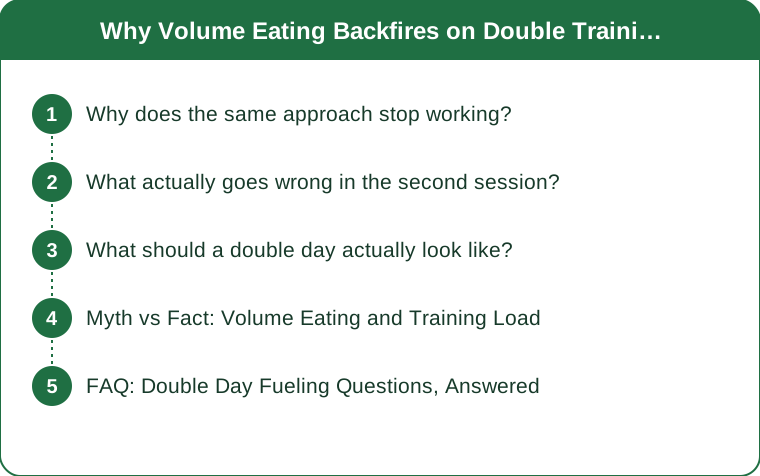
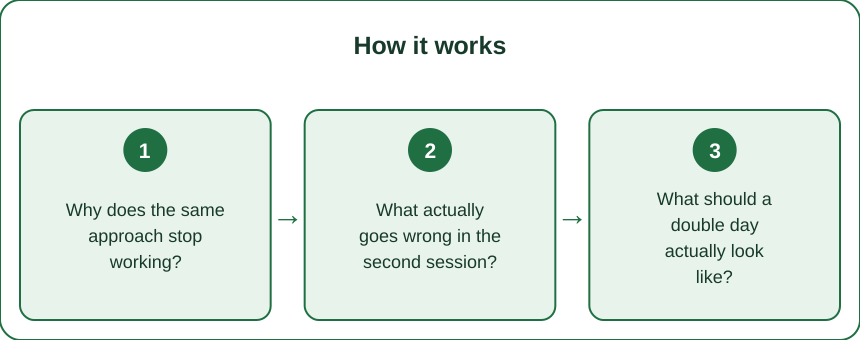
Why does the same approach stop working?
Because volume eating deliberately breaks the link between how much you eat and how much energy you get.
That is its entire mechanism. Foods with high water and fiber content — vegetables, broth soups, berries, high-volume grains — take up substantial stomach space at very low calorie density. Stomach distension is a real satiety signal, so you feel genuinely full on relatively few calories. On a deficit, this is extremely useful.
The limit is physical. Your stomach has a working capacity of roughly 1 to 1.5 liters comfortably. When your energy needs are modest, that capacity is plenty. When you add a second training session, your needs might rise by 400 to 800 calories while the capacity has not moved an inch.
So you run out of room before you run out of requirement. Volume eating has quietly become a ceiling rather than a tool.
There is a second effect: high fiber and high volume slow gastric emptying. Feeling heavy and full going into an evening session is uncomfortable, so people eat less close to training — which compounds the underfueling at exactly the wrong moment.
What actually goes wrong in the second session?
Glycogen, mostly, and it presents in a recognizable pattern.
Muscle glycogen is your primary fuel for anything at moderate-to-high intensity. A hard session depletes a meaningful fraction of it, and refilling it requires carbohydrate specifically — not fullness, not protein, not volume. If the meal between sessions is a large salad, you are full and you have replaced very little glycogen.
The symptoms are consistent: you feel fine in the warm-up, then power drops off in the second half, your perceived effort is high at ordinary loads, and coordination gets slightly worse. It looks like fatigue from the first session, which is why it gets attributed there.
Athletes with less than about four hours between sessions are the most exposed, because there is limited time to eat enough. Guidance for rapid refueling in that window typically points to something in the range of 1 to 1.2 grams of carbohydrate per kilogram of body weight per hour — and that is genuinely hard to reach on high-volume, low-density food.
There is also a cumulative version. Do this two or three times a week and you carry a chronic partial glycogen deficit, which shows up as flat sessions across the board, poor recovery, and often a stalled progression that gets blamed on programming.

What should a double day actually look like?
Split your day into volume meals and fuel meals, and be explicit about which is which.
Fuel the pre- and between-session meals with density. These are the two meals where volume is a liability. Think rice, pasta, potatoes, oats, bread, bananas, dried fruit, honey, yogurt — foods that carry a lot of carbohydrate in a small physical package. A bowl of rice with chicken is a better between-session meal than twice its weight in vegetables and lean protein.
Use liquids between sessions. A smoothie or a shake with fruit, oats and milk delivers substantial carbohydrate with far less stomach load and empties faster than solid food. This is the single most practical fix on the list, and it is why athletes on tight turnarounds drink their calories.
Keep volume eating for the meals furthest from training. Breakfast on a light morning, or dinner after everything is done, is where the big high-volume bowl belongs. You get the satiety benefit without paying for it in performance.
Add fat where volume was. Nuts, oils, nut butter, cheese, avocado — a small amount adds meaningful calories without stomach space. On a high-demand day this is a feature, not something to minimize.
Time it deliberately. Aim for the substantial carbohydrate meal 2 to 3 hours before the second session, with something small and easy 30 to 60 minutes out if needed.
A rough target to sanity-check against: on a two-session day, most people need an extra 300 to 600 calories over a single-session day, weighted toward carbohydrate. If your intake looks identical to a rest day, that is the finding.
Myth vs Fact: Volume Eating and Training Load
Myth: If you are full, you have eaten enough. Fact: Fullness is a stomach distension signal. It is not a measure of calories, carbohydrate or protein, and volume eating specifically decouples the two.
Myth: Volume eating is always the healthier choice. Fact: It is a tool for managing appetite in a deficit. On a high-demand day, energy density is the appropriate tool. Neither is inherently better.
Myth: You can make up the calories at dinner. Fact: For total daily intake, partly. For the second session’s performance, no — the fuel had to be there before you trained, and one large late meal often is not physically comfortable anyway.
Myth: More fiber is always better. Fact: Fiber is valuable and around training it can be a problem, causing fullness and GI discomfort. Most sports nutrition guidance suggests lowering fiber in the hours immediately before hard sessions.
Myth: Feeling light and empty means you are ready to train. Fact: It often means you are underfueled. A slight sense of having eaten is normal and appropriate before a hard session.
FAQ: Double Day Fueling Questions, Answered
What if I am trying to lose weight and still train twice?
Run the deficit on your easier days and eat close to maintenance on double days. Spreading a uniform deficit across a week with wildly varying demand is what produces flat sessions and stalled progress.
How long between sessions before this stops mattering?
With six or more hours and two normal meals in between, most people manage fine on ordinary eating. Under four hours is where deliberate density and liquids matter most.
Is a shake really better than a meal?
Between sessions on a short turnaround, generally yes — faster gastric emptying, less fullness, easier to consume when appetite is suppressed after hard training. As a general dietary strategy, no.
Does this apply to two easy sessions?
Much less. Two easy or technical sessions do not deplete glycogen the way two hard ones do. The issue scales with intensity and duration, not with the number of sessions.
How do I know if this is happening to me?
The pattern to look for: consistently worse second sessions, feeling full but flat, and a good first session followed by a poor evening. Log a couple of double days honestly and the answer is usually obvious. This is general information, not medical advice — a registered dietitian is worth consulting for a real training load.
TL;DR:
- Volume eating works by decoupling fullness from calories — which becomes a ceiling when your energy demand rises.
- Stomach capacity stays around 1 to 1.5 liters while a double day can add 400 to 800 calories of need.
- Second-session flatness is usually glycogen, not residual fatigue, and carbohydrate is the only thing that refills it.
- Make the pre- and between-session meals energy-dense, use a liquid option on short turnarounds, and save the big volume bowl for after everything is done.
You were full and you were underfueled. Those have never been the same measurement.
Keep Reading
This article is for general informational purposes only and is not medical advice. Always consult a qualified health professional for guidance specific to you.