Why Volume Eating Collapses on Travel Days and What to Do Instead
Quick Answer: Volume eating depends on three things travel removes at once - a fridge, preparation time, and easy access to high-water, high-fiber foods. Travel food is the opposite: dense, dry, and shelf-stable. The workable substitute is to switch from volume to protein and structure for the trip, rather than trying to recreate a strategy the environment cannot support.
At home you eat enormous, satisfying meals and never feel deprived. Then you spend a day traveling and by evening you have eaten a bag of pretzels, a coffee, and a sandwich, and you are both stuffed and unsatisfied.
Volume eating is a genuinely effective approach with one significant dependency: it needs an environment that supplies bulky fresh food. Travel is the environment specifically designed not to.

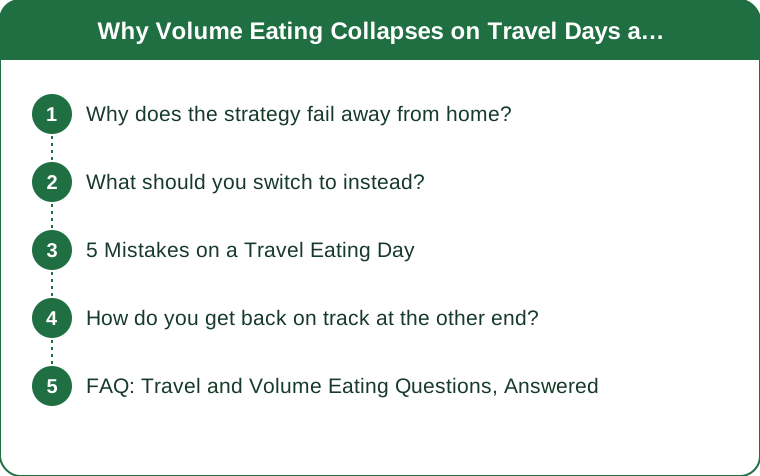
Why does the strategy fail away from home?
Because everything volume eating relies on is a property of your kitchen, not of your willpower.
Volume eating works by using water and fiber to fill you up at a low calorie cost. Vegetables, fruit, broth-based soups, and high-water proteins fill your stomach and trigger the stretch signals that contribute to feeling full. It is a clever exploitation of how satiety actually works.
Every one of those foods is perishable, bulky, and needs refrigeration or preparation. Which is precisely why travel food is not made of them. Shelf-stable food is by definition dehydrated and calorie-dense - the water has been removed so it does not spoil.
So travel food is the exact inverse of volume food. Crackers, nuts, bars, sandwiches, and pastries deliver a lot of calories in very little stomach volume. You can eat a large number of calories and still get almost no fullness signal.
There is also a schedule problem. Volume eating usually involves larger, less frequent meals that take time to eat. Travel forces small, opportunistic eating at whatever moment food happens to be available.
And a water problem. Traveling tends to dehydrate you - dry cabin air, less convenient water access, more caffeine - and thirst is frequently misread as hunger. Some of the travel-day snacking that feels like appetite is straightforwardly thirst.
What should you switch to instead?
Protein and structure, deliberately chosen as a temporary substitute rather than as a failure.
Make protein the anchor of every travel meal. Protein is the most satiating macronutrient per calorie and, unlike water and fiber, it travels well. Jerky, tuna packets, protein bars with a genuinely high protein content, hard-boiled eggs, and cheese all survive a bag.
Eat on a schedule rather than on availability. The single biggest travel-day change. Decide roughly when you will eat and eat then, instead of grazing whenever a shop appears. Structure replaces the fullness that volume normally provides.
Buy the fresh option when it exists. Airport and service station food has improved substantially - a salad with chicken, a fruit cup, a soup - and those options do provide some volume. The mistake is deciding in advance that nothing good will be available and defaulting to snacks.
Drink deliberately. A large water at every stop. It addresses genuine dehydration and it removes the thirst-mistaken-for-hunger cycle that drives a lot of travel snacking.
Bring one high-volume item that travels. An apple, a bag of baby carrots, or a couple of oranges survive a day in a bag and provide the bulk that nothing else in the airport will.
And accept a slightly higher calorie day. A travel day eaten sensibly but denser than usual is not a problem. Trying to run a strict volume approach in an environment that cannot support it produces exactly the all-or-nothing collapse that ends with the pretzels.

5 Mistakes on a Travel Eating Day
1. Not eating before you leave. Starting a journey hungry means your first food decision happens in the worst possible environment with the least patience. A proper high-volume, high-protein meal at home before departure covers the first several hours and is the highest-return thing on this list.
2. Packing only snacks. Snack foods are engineered to be easy to eat a lot of, and a bag of them plus a long journey is a predictable outcome. Pack meals - something that constitutes an actual eating event - not just things to nibble.
3. Treating coffee as a food strategy. Caffeine blunts appetite temporarily and then it wears off, usually at the least convenient moment, and it worsens the dehydration that is already driving false hunger.
4. Trying to be perfect. The rigid version of a food approach is the version that breaks. A travel day where you eat a denser diet than usual and remain roughly on track beats a strict plan that collapses at hour six.
5. Arriving with nothing planned for the first evening. The end of a travel day is when decision fatigue is highest and options are worst. Knowing where dinner is coming from before you arrive removes the moment where everything unravels.
The pattern across all five: travel days go wrong at the transitions, not in the middle.
How do you get back on track at the other end?
Quickly and without ceremony, and with one specific first step.
Make the first meal at your destination a volume meal. A large salad, a big bowl of soup, a substantial vegetable-heavy dish. It resets both the physical sensation you are used to and the psychological thread of the approach.
Find the food source in the first day. If you are somewhere for more than a couple of days, locating a shop with fresh produce within the first day changes the entire trip. Even a hotel room with no kitchen supports fruit, pre-washed vegetables, yogurt, and pre-cooked protein.
Rehydrate properly for a full day rather than one glass. Travel dehydration takes longer to resolve than most people assume, and until it does your hunger signals are not reliable.
Do not compensate by restricting. Eating notably less the day after a dense travel day tends to produce a rebound rather than a correction, and it turns one unusual day into a several-day cycle.
And expect the scale to be strange for a few days. Travel, denser food, more sodium, disrupted sleep, and altered fluid balance all move water weight substantially. It is not fat, it resolves, and weighing yourself the morning after a flight is mostly a way to feel bad about a number that means nothing.
One seasonal note worth adding: as autumn arrives, the volume approach actually gets easier in some ways and harder in others. Cold-weather appetite tends to rise, and cold food is less appealing - but soups, stews, and roasted vegetables are excellent volume foods and suit the season perfectly. A big pot of vegetable soup is the single most useful autumn adaptation of this whole approach.
This is general nutrition information rather than individual advice - if you have a medical condition or a history of disordered eating, work with a professional who knows your situation.
FAQ: Travel and Volume Eating Questions, Answered
What is the single best food to pack?
Something with real protein that needs no preparation - jerky, a tuna packet, or hard-boiled eggs for a shorter trip. Add one piece of whole fruit for the bulk that nothing else in your bag will supply.
Should I skip meals on travel days to compensate?
No. Skipping meals on a long travel day reliably produces a much larger, less controlled meal at the end of it, and it makes the whole day harder to manage.
How do I handle a hotel with no fridge?
Most hotel rooms support more than people expect - whole fruit, pre-washed vegetables, shelf-stable protein, and instant oats made with the kettle. Ask about a fridge at check-in too, since many properties have them available on request.
Is volume eating still the right approach for a longer trip?
For anything over a few days, yes, and it becomes achievable again once you have found a shop. It is specifically the transit days that cannot support it.
TL;DR:
- Volume eating depends on a fridge, prep time, and bulky fresh food, and travel removes all three at once - shelf-stable food is dehydrated by definition.
- Switch to protein and a fixed eating schedule for transit days rather than trying to recreate the approach without its inputs.
- Eat a proper volume meal before you leave, pack meals rather than snacks, and drink at every stop.
- Make the first meal at your destination a high-volume one, and do not restrict the next day to compensate.
The approach did not stop working. You just took it somewhere that does not sell the food it runs on.
Keep Reading
This article is for general informational purposes only and is not medical advice. Always consult a qualified health professional for guidance specific to you.