Frozen or Fresh: Which Actually Gives You More Food?
Quick Answer: For volume eating, fresh generally wins on raw bulk and frozen wins on cost, waste and consistency. Freezing ruptures cell walls, so frozen vegetables release water and collapse when cooked — frozen spinach loses far more apparent volume than fresh does. The practical answer is to use fresh for the raw and lightly cooked bulk that fills the plate, and frozen for the cooked base of soups, stir fries and bowls where collapse does not matter.
Both belong in the freezer and the fridge; the mistake is using one for the other’s job.
We have covered water content versus fiber, grocery staples and batch cooking. This is the buying decision that sits underneath all of them.
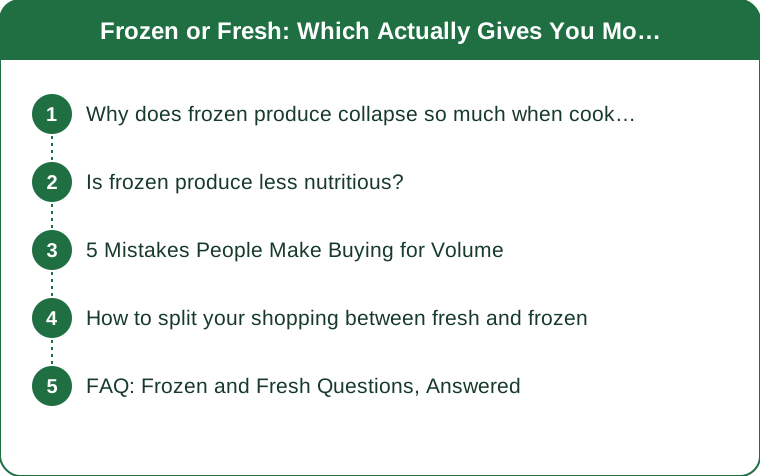
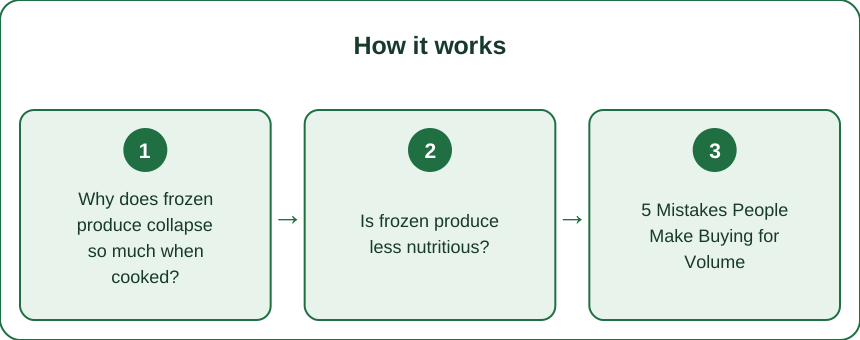
Why does frozen produce collapse so much when cooked?
Because of what freezing does to the cell walls, and it is physical rather than nutritional.
Water expands as it freezes. Ice crystals form inside plant cells and puncture the cell walls from the inside.
On thawing, that water runs out. The structure that held the vegetable up is compromised, so what was a rigid leaf becomes a soft mass.
Which is why frozen spinach reduces so dramatically. A large bag of frozen spinach cooks down to a fraction of the volume, and it happens faster and further than with fresh.
Commercial flash freezing limits the damage. Very rapid freezing produces smaller crystals and less cell rupture, which is why commercially frozen produce holds up much better than home-frozen.
Blanching before freezing also matters. It deactivates enzymes that would otherwise degrade texture, which is why commercial frozen vegetables keep better than an unblanched bag from your own kitchen.
Denser vegetables survive better. Broccoli florets, green beans and peas hold their shape reasonably well; leafy greens and courgette collapse most.
Is frozen produce less nutritious?
Generally no, and in some cases it is better than what is in the fridge.
Produce is usually frozen within hours of harvest. Fresh produce may travel for days and then sit in a shop and a fridge for several more.
Water-soluble vitamins degrade over time and with light. Vitamin C in particular declines steadily in fresh storage, so a week-old fresh pepper may have less than a frozen one picked at peak.
Blanching costs a little at the start. The brief heat before freezing does reduce some vitamin C, which is the main nutritional trade-off.
Fat-soluble vitamins and minerals are largely unaffected by freezing in either direction.
Fiber is completely unaffected, which matters for volume eating because fiber and water are what produce satiety.
The honest summary: the difference between fresh and frozen is much smaller than the difference between eating vegetables and not eating them, and frozen dramatically reduces the barrier to the second.
5 Mistakes People Make Buying for Volume
Mistake one: buying fresh leafy greens in bulk. They are the highest-volume item in the shop and the fastest to spoil. Buying a week’s worth on Sunday means throwing half of it out on Friday, and the volume you paid for never reaches a plate.
Mistake two: using frozen for salads and raw bulk. Frozen produce cannot do the job of raw crunch. Thawed cucumber and courgette are unusable for that purpose, and this is the swap that puts people off frozen entirely.
Mistake three: cooking frozen vegetables from thawed. Cooking from frozen, hot and fast, limits the water release. Thawing first guarantees a soggy result and maximum collapse.
Mistake four: judging frozen by the bag size. Frozen weights are usually more honest than fresh, since fresh includes stems, cores and outer leaves you will discard. A 500g bag of frozen broccoli is closer to 500g of eaten broccoli than a 500g head is.
Mistake five: ignoring frozen fruit. Frozen berries are among the best value volume items available, they blend to a far greater apparent volume than fresh, and they do not spoil at the back of the fridge.
And the one that costs the most money: buying fresh for meals four days out. Anything you plan to eat later in the week is a frozen job, and that single rule cuts most produce waste.
How to split your shopping between fresh and frozen
Six rules that make the decision automatic.
Fresh for raw and for the first two days. Salad leaves, cucumber, peppers, tomatoes, anything eaten uncooked or barely cooked.
Frozen for the cooked base of everything. Soups, stir fries, curries, bowls, anything where the vegetable is going to soften anyway. Collapse does not matter when the dish is already soft.
Frozen for the back half of the week. Plan the last three days of meals around the freezer and you stop throwing food away.
Frozen berries for anything blended or heated. Cheaper, always available, and a frozen banana blended with frozen berries produces roughly double the apparent volume of the same ingredients at room temperature.
Buy fresh for the highest water content items you eat raw. Cucumber, lettuce, celery and tomato are the volume workhorses and none of them freeze usefully.
And cook frozen from frozen, hot and fast. A hot pan, no lid, no thawing. It limits water release and gets you closer to fresh texture than any other technique.
One late-summer note: this is the tail of the cheap fresh produce season in most regions. Buying fresh in bulk now and freezing it yourself works reasonably for peppers, berries and beans, though home freezing without blanching produces more collapse than commercial does.
FAQ: Frozen and Fresh Questions, Answered
Is frozen produce less healthy than fresh?
Generally not. Frozen is usually processed within hours of harvest, while fresh may take days to reach you and then sit in a fridge. Blanching costs a little vitamin C, but fiber, minerals and fat-soluble vitamins are essentially unaffected.
Why does frozen spinach shrink so much more than fresh?
Ice crystals rupture cell walls during freezing, so the water that held the leaf rigid runs out on thawing. Fresh spinach also wilts, but it retains more structure because those walls are intact until you cook it.
Should I thaw frozen vegetables before cooking?
No, for texture. Cooking from frozen in a hot pan without a lid limits how much water is released and keeps the vegetables closer to fresh texture. Thawing first almost guarantees a soft, watery result.
TL;DR:
- Fresh wins for raw bulk; frozen wins for cost, waste and the cooked base of meals.
- Freezing ruptures cell walls, which is why frozen greens collapse far more on cooking.
- Nutritionally the two are close, and frozen sometimes beats week-old fresh.
- Cook frozen from frozen, hot and fast, and plan the back half of your week around the freezer.
Buy fresh for what you eat this week raw, and frozen for everything that ends up in a pan.
Keep Reading
This article is for general informational purposes only and is not medical advice. Always consult a qualified health professional for guidance specific to you.