Why Soup Might Be the Most Underrated Volume-Eating Tool You're Not Using
Quick Answer: Broth-based soups add water volume directly into the food itself, which research links to greater fullness per calorie than eating the same ingredients separately with a glass of water on the side. A vegetable-heavy, broth-based soup can deliver real fullness for under 200 calories per large bowl.
You’ve built salads, grain bowls, and stir-fries into your volume-eating rotation, but soup rarely makes the list — probably because it doesn’t feel like a full meal. That instinct is backwards, and the reason has to do with how your stomach actually measures fullness.

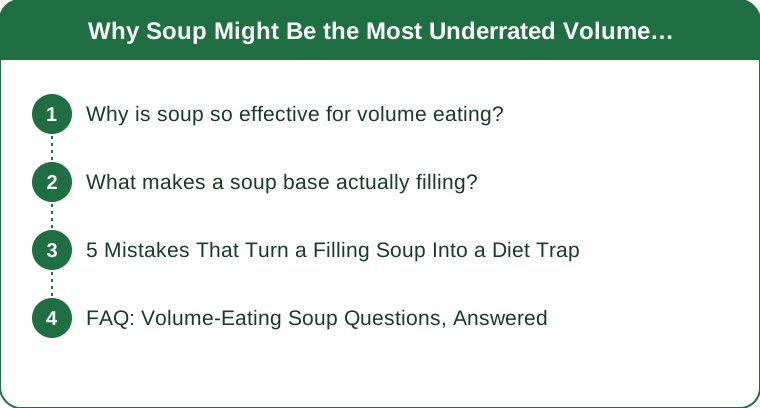
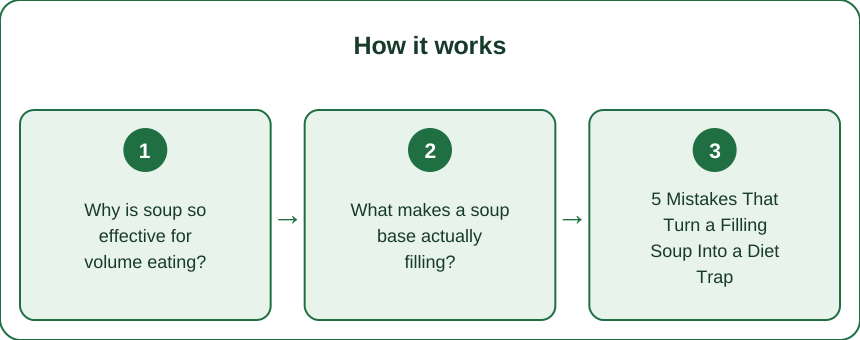
Why is soup so effective for volume eating?
Because water incorporated into food registers differently than water drunk alongside it. Studies on soup versus the same ingredients eaten as a casserole with a side of water found soup produced greater fullness on fewer calories, even though the nutrient content was nearly identical.
The stomach’s stretch receptors respond to the total volume present at once — a blended or brothy soup delivers that volume in a form that’s calorically cheap to produce.
What makes a soup base actually filling?
Broth over cream, and chunky over fully blended. A clear vegetable or chicken broth base keeps calories low while still carrying real volume, whereas cream-based soups add 100-200 calories per cup with minimal extra fullness benefit.
Keeping some texture — beans, shredded chicken, or chopped vegetables — versus a fully pureed soup also seems to extend fullness slightly longer, since a little chewing signals the brain that a real meal happened.

5 Mistakes That Turn a Filling Soup Into a Diet Trap
1. Starting with a cream or coconut milk base. Instantly adds 150+ calories without adding volume.
2. Skipping protein entirely. A vegetable-only soup fills you up for an hour, not an afternoon — add beans, lentils, or shredded protein.
3. Pairing it with bread by default. A side of bread can double the meal’s calories while soup alone was already doing the filling work.
4. Making it too thin. Watery broth with almost no solids doesn’t carry the same fullness signal as a soup with real vegetable and protein content.
5. Under-seasoning. A bland soup gets abandoned halfway through the bowl — bold flavor (herbs, acid, chili) keeps you eating the full filling portion.
FAQ: Volume-Eating Soup Questions, Answered
Can soup alone be a full meal?
With enough protein and fiber — beans, lentils, shredded chicken, plus a variety of vegetables — a large bowl of soup can absolutely function as a complete, filling meal, not just a starter.
Is blended soup as filling as chunky soup?
Both deliver the volume-eating benefit from the water content, but chunky soups tend to extend fullness slightly longer due to the added chewing and texture.
How much soup counts as a filling portion?
Aim for roughly 2-3 cups of a broth-based, ingredient-rich soup as a main meal — that volume is what triggers meaningful stomach-stretch fullness signals.
TL;DR:
- Water blended into food fills you up more per calorie than water drunk on the side
- Broth-based, protein-rich soup beats cream-based for the volume-eating goal
- Keep some texture — full purees fill you up slightly less than chunky soups
- Skip the bread side; let the soup itself do the filling work
A big pot of vegetable-and-bean soup might be doing more for your fullness than the salad you’ve been building every day instead.
Keep Reading
This article is for general informational purposes only and is not medical advice. Always consult a qualified health professional for guidance specific to you.