How to Keep Volume Eating Going When You're Stuck in a Hotel Room
Quick Answer: Travel volume eating works by leaning on water-rich foods that don’t need a stove — pre-washed vegetables, canned beans rinsed to cut sodium, and broth-based instant soups upgraded with extra vegetables from a nearby grocery store. A hotel mini-fridge and a kettle cover almost everything you need.
Hotel rooms feel like a dead end for anyone used to volume eating at home, where a big pot of soup or a loaded stir-fry is the default. With a small grocery run and a couple of easy substitutions, the same principle travels just fine.
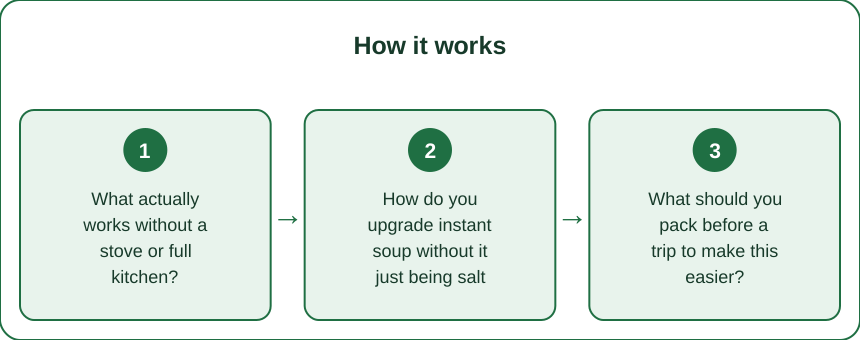
What actually works without a stove or full kitchen?
Pre-cut vegetables and pre-washed salad greens are the backbone — no prep equipment needed beyond a knife, and most hotel gyms or lobby areas have a communal microwave if your room doesn’t. A rotisserie chicken from a grocery store, torn into a big bowl of greens with beans and a light dressing, delivers the same volume and satiety as a home-cooked bowl meal.
A hotel room kettle, meant for tea, works well for softening quick-cook grains like couscous or instant brown rice, which bulk up a meal significantly for very little added calories.
How do you upgrade instant soup without it just being salt and noodles?
Buy a bag of pre-washed spinach or baby kale and stir a big handful into the hot broth right before eating — it wilts in under a minute and adds real volume and nutrients to what’s otherwise a low-substance meal. Adding a can of beans, rinsed well to cut the sodium, turns a snack-sized soup into an actual filling meal.

What should you pack before a trip to make this easier?
A reusable bowl or container, a couple of packets of a favorite hot sauce or seasoning blend (hotel food is often bland), and a compact list of what to grab at a local grocery store on arrival — pre-washed greens, a rotisserie protein, canned beans, and fruit — turns the first hour in a new city into a simple stock-up rather than a scramble.
Myth vs Fact: Eating Well While Traveling
Myth: You need a full kitchenette to eat filling meals on the road. Fact: A mini-fridge and a kettle cover the vast majority of volume-eating staples with minimal prep.
Myth: Hotel room eating always means fast food or vending machines. Fact: A 10-minute grocery run on arrival sets up several days of filling, low-effort meals without touching a restaurant menu.
FAQ: Volume Eating While Traveling, Answered
What’s the single best grocery item to buy first when arriving at a hotel?
Pre-washed salad greens or spinach — they add volume to almost anything (soup, a bowl, even a sandwich) and don’t spoil as fast as people assume in a mini-fridge.
How do you keep food cold without a real fridge?
Most hotel mini-fridges, even small ones, keep produce and rinsed beans fine for 2-3 days. For longer stays, ask the front desk — many hotels can provide a small cooler or extra ice on request.
Is it worth packing food from home for a short trip?
For a 2-3 day trip, it’s usually not necessary — a single grocery stop covers it. For longer stays, packing a few shelf-stable staples (oatmeal packets, a favorite seasoning) saves repeated store trips.
TL;DR:
- Pre-washed greens, canned beans, and a rotisserie protein cover most travel volume-eating needs
- A hotel kettle works for quick grains; a communal microwave covers reheating
- Upgrade instant soup with greens and rinsed beans instead of eating it plain
- One 10-minute grocery stop on arrival sets up several easy, filling days
Volume eating doesn’t require your home kitchen — it just needs a slightly different shopping list.
Keep Reading
This article is for general informational purposes only and is not medical advice. Always consult a qualified health professional for guidance specific to you.